Garden Square residents speak out about living in public housing (Kokomo Tribune)

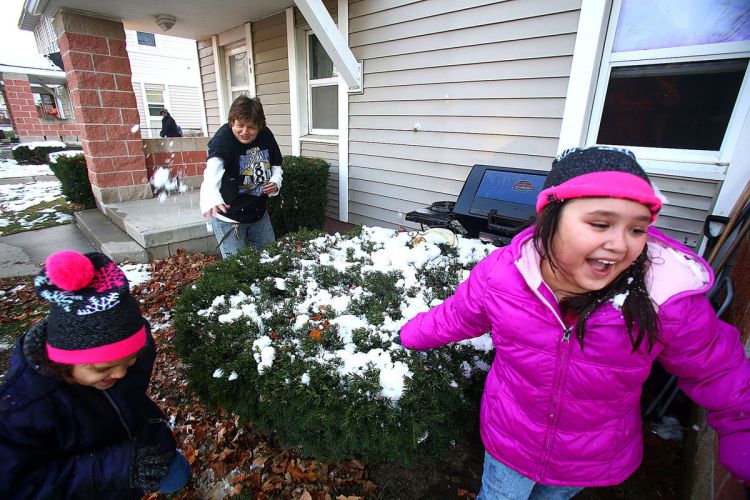
Garden Square residents Yanette and Maria Ayala have a snowball fight with their aunt Bobby Thieke on Nov. 24, 2015. (Tim Bath | Kokomo Tribune)

It’s well below freezing, but Jackie Peden starts the morning of Feb. 10 like she does every day: opening the front door of her Garden Square apartment to signal to the children they can come and go as they please.

A boy in first grade steps into her kitchen at about 8:15 a.m. that snowy Wednesday. She has the oven on and open to pump more heat into the room for the children trying to escape the cold. The boy admires the many magnets on Peden’s fridge and asks if he can have one that’s half of a Hot Wheels van. She asks him what happened to the one he took the day before, and then concedes to his request.

“There’s no cookies?” the boy asks.

Peden – who everybody in Garden Square knows as Ms. Jackie – stands from her wheelchair and retrieves a box of Thin Mint cookies from her freezer. She’s going through Girl Scout cookies fast these days, and in the summer she starts stocking popsicles. Peden has an obvious soft spot for children, offset by her role as firm disciplinarian and “playground monitor,” as she calls herself. She hands out treats but also keeps a wooden paddle she calls “Oscar” tucked in the back pocket of her wheelchair.
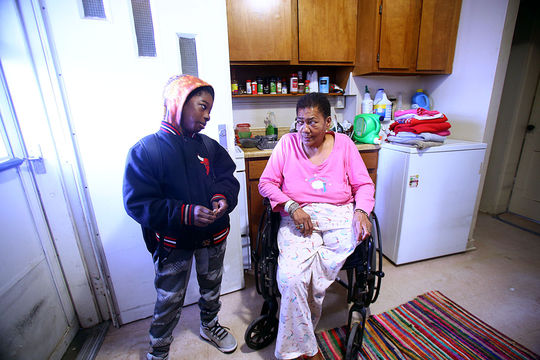
Trevion Foster waits in Jackie Peden's kitchen for the school bus on Feb. 26, 2016. Ms. Jackie, as the kids know her, always has a few motherly words of advice or a treat for the kids. (Tim Bath | Kokomo Tribune)
Trevion Foster waits in Jackie Peden’s kitchen for the school bus on Feb. 26, 2016. Ms. Jackie, as the kids know her, always has a few motherly words of advice or a treat for the kids. (Tim Bath | Kokomo Tribune)

“Don’t be bouncing off the walls when you go to school,” Peden, 61, admonishes the boy, handing him some cookies. The storm door bangs as four older children step into Peden’s apartment, filling her kitchen, and she doles out three cookies to each of them as well.

At about 8:30 a.m., a yellow school bus comes to a stop at the corner and the children rush out the door, leaving behind puddles of mud where the snow had melted from their shoes.

“Bye, you all have a good day,” Peden calls after them.

“This is how my day starts,” she says, alone now in her kitchen. “I love it, yes I do.”

Concentrated poverty

Peden’s special attention to her young neighbors is echoed again and again throughout the public housing complex – by other Garden Square residents, by the Kokomo Housing Authority, by Kokomo Urban Outreach just across South Locke Street and by numerous other community groups.

They want the next generation to grow up with the hope of something more.

Debra Cook, executive director of the Kokomo Housing Authority, has a passion for helping children break the cycle of poverty, as well.

“We have to change the culture. In order to do that, I put a lot of resources into working with kids,” she said, noting KHA’s recent investments in social services for its residents. “While we are a housing authority and we do provide housing, we have to think about the long-term success of our residents and how they fit in the community. The best way to serve them and make their lives better is to also work on the social side of things.”

Kiah Anderson, 4, (center) waits for someone to push her on the swings at one of the playgrounds at Garden Square Apartments on Saturday, February 27, 2016. (Kelly Lafferty Gerber | Kokomo Tribune)

Some Garden Square residents – like Peden – have elected to live there for decades. A woman who lives in the next row over from her has a couple nieces who also reside in the complex. Two sisters who grew up visiting their grandmother in Garden Square now live in opposite corners of the complex, each raising their own children there now.

Whether residents see it as a stepping stone or a long-term residence, for at least the immediate future, Garden Square is home.

Previously called Gateway Garden, the public housing complex is often labeled as a hub for drug activity and associated with violence, a somehow second-rate place to live, thereby making the people who live there second-rate citizens.

The people who live in Garden Square are aware of its reputation in the broader community.

The people who live there would like that perception to change.

“Yes, it’s low-income, but that don’t mean that we’re low-minded people,” said Angela Small, 49, who has lived in Garden Square for about two-and-a-half years. She still has her mail sent to her mother’s address when possible because she doesn’t see the apartment complex as her permanent residence. “These are family-oriented people up in here. These people look out for their kids and other kids up in here.”

Some people say the drug activity in Garden Square has been cleaned up in recent years; their neighbors say it’s worse than it used to be. Drug- and alcohol-related arrests in the complex peaked in 2007, but many residents also say it’s unlikely they will call the police about drug activity – out of fear of retaliation, or thinking it won’t make a difference. The smell of marijuana drifts through the complex when the wind is just right, and some residents have heard teenagers have been smoking spice there lately.

Most residents say the violence isn’t bad, but they try to be careful and keep to themselves. Children talk about fights they’ve seen in the complex, and they fight with each other.

There’s good and bad in every neighborhood.

Inside Garden Square

Kokomo Housing Authority provides the safety net for city residents whose financial situation gives them few options. Divorce, medical conditions, lay-offs, underemployment and addiction are common paths to poverty. For many, it becomes incredibly difficult to make a change once they are focused on surviving day-to-day rather than planning long-term.

Some residents of Garden Square would like to own their own homes or dream of having a kitchen large enough for a dining room table and chairs. They would prefer for their grandchildren to play on soft carpet in their living rooms rather than hard tile floors.

The 76-year-old complex consists of 176 units divided into six rows of four buildings at 800 E. Hoffer St. in Kokomo. Sidewalks connect the rows of tan buildings, with white trim and black roofs, which were remodeled in 2000. Children often gather in the complex’s four courtyards to play on the three playgrounds and basketball court. A community building at the north end of the complex houses offices, activities for residents and a daily after-school Homework Club for children of all ages.

Families pay roughly 30 percent of their monthly income in rent, which includes all utilities and Wi-Fi in Garden Square. There’s about a year-long waiting list to move in, and roughly 528 people live there when it’s at capacity.

“Do I like being in the situation I’m in? No. Is [Garden Square] a blessing to me? Yes. I could not have asked for a better place to live,” said Melissa Sterner, 46, who goes by Missy and has lived in Garden Square three different times throughout her life, most recently since 2008. “This place is basically like home. If we could make the inside look as good as the outside, people would probably take better care of it.”

Cook knows concentrated poverty is not ideal. In addition to the five public housing properties KHA manages, the housing authority also oversees about 700 single-family homes scattered throughout the city. Cook and her staff of 40 people have expanded KHA’s role beyond simply providing housing to address residents’ other needs as they work toward being self-sufficient.

“We want families to have the opportunities to live in mixed income areas. It’s not good to cluster,” Cook said. “[Mixed income neighborhoods] expose the families to different levels of income and the amenities that might be in one income level versus another.”

Differing perceptions

Sarah Birden never wanted to live in a place like Garden Square.

“I wouldn’t raise my dog out here,” Birden said, often speaking softly and slowly, like she’s almost too tired to form the words. “I worked very, very hard to make sure that my children never had to experience something like this.”

Birden, 32, a Kokomo native, and her husband previously owned a house near Pettit Park, both bringing in an income to support their five children, now ages 7 to 17. In 2007, Birden was diagnosed with cancer and continues to struggle with several other serious medical issues, too.

Separated from her husband and no longer able to hold down her factory job due to her health, Birden lost her house. She and her children moved into Garden Square in 2013, living on child support from her husband and food stamps.

Birden sat crying on the cement step out the back door of her apartment one sunny October afternoon, the wind whipping her long, dark hair. She was simply overwhelmed.
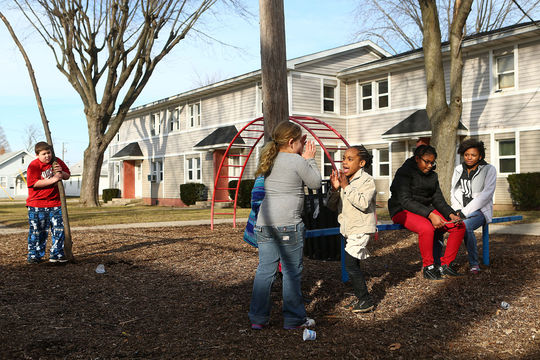
Center: Bella Kanable, 8, and Myaire Jackson, 5, play a hand clap game on one of the playgrounds at Garden Square Apartments on Saturday, February 27, 2016. (Kelly Lafferty Gerber | Kokomo Tribune)

Birden worries about her children growing up around negative influences.

“It’s like beating it off with a stick. You have to fight 10 times harder to keep your kid from falling down that path [of drugs, gang affiliations and violence],” she said.

But Birden also doesn’t want her children to look down on their neighbors, so she tries to explain the differences in where they live now and their old neighborhood.

“The easiest thing I’ve found to be able to get through to most of them is that every person is raised differently and they see different things from different places that they come from,” she said. “Some people don’t have the pleasure of good parenting from the beginning, and you just fall down a path that’s easy to follow. I’ve tried to instill that in them so that they see they’re very lucky compared to a lot of kids out here. They’ve had a full-time parent who’s been there to give them the right direction, to give them the right help, to keep them away from those things. Not everybody does.”

Michelle Jackson and Danielle Watts are thrilled to be raising their children in Garden Square.

They both moved to Kokomo from public housing in Chicago, seeking a more peaceful environment. They found it.

“There’s not a lot of fighting and guns,” said Jackson, 35, who applied online to be transferred to another public housing complex outside Chicago. Kokomo was the first place that had a spot for her, and she moved in August 2015. “I really, really like the Homework Club. I like that they really pay attention to the kids and try to keep them out of trouble.”

Jackson has a 12-year-old son and a 5-year-old daughter. The teenage girl who lives next door often babysits them. In addition to attending the KHA’s nightly Homework Club, Jackson’s daughter also joined a Girl Scout troop organized by Kokomo Urban Outreach. Her son participates in Wednesday night youth group at Greater Life Church in Greentown. People from the church provide transportation for children who live in Garden Square who want to attend.

Watts, 24, has had a similarly positive experience for herself and her 8-year-old daughter since they moved to Garden Square in February 2015. Watts didn’t know anyone in the area when they came to Kokomo; she was simply looking to get out of Chicago.

“With all the violence that was going on in Chicago, I did some research on the Internet and there were three different cities I wanted to go to. Kokomo was one of them,” she said, adding that she got in to Garden Square within a couple months of applying. “I think people look at me kind of weird. I don’t know if it’s because I’m African American or because I’ve got [purple] colored hair, I don’t know. But I just like it because it’s like peaceful, you know. You don’t have to deal with a whole bunch of nonsense all day, every day, like violence or cursing.”

Watts carried an umbrella to keep the rain off her as she crossed the complex to check her mail on a cool day in October. She still wore her ID badge from the Excel Center, a charter school in Kokomo for adults who want to earn their high school diplomas. When she’s not in class, Watts appreciates the chance to keep busy with the eight hours of community service work KHA requires residents to complete each month, unless they meet certain federal requirements to be exempted.

“It’s crazy, people call this the projects and I’m like this ain’t nothing,” Watts said.

Children leave Jackie Peden's kitchen to hop on the school bus on Feb. 26, 2016. Peden allows the children to wait for the bus in her apartment so they can stay warm during the winter months. (Tim Bath | Kokomo Tribune)
Children leave Jackie Peden’s kitchen to hop on the school bus on Feb. 26, 2016. Peden allows the children to wait for the bus in her apartment so they can stay warm during the winter months. (Tim Bath | Kokomo Tribune)

Unsupervised children

Stephanie Reed says her children know more people in the neighborhood than she does.

That’s typical for many families in Garden Square. The vast majority of public housing residents on Kokomo’s south side are women and children, so when mom’s at work, the children entertain themselves.

Minority women, especially, are more likely to be victims of crime, said Gregory “Fritz” Umbach, an expert on public housing and an assistant professor at the John Jay College of Criminal Justice at the City University of New York. Unsupervised children are another factor in that equation, he added.

“If you have a large number of children with less adult supervision, that can be a predictor of crime,” Umbach said.

Reed, 34, a Kokomo native, was bumped up to full-time at the restaurant she works at about a year ago, and in December she was promoted to manager. When she’s not at work, she stays in her apartment trying to avoid the “drama” that goes on in the complex.

“Come summer time, all you got to do is pop a bag of popcorn, sit right there on the porch and see all the action,” she said, standing in her kitchen on New Year’s Eve as her teenage children come and go through the room.

Reed estimates she and two of her children have lived in Garden Square for three years, aside from the few months last year they were evicted because her son was playing with a knife outside in one of the courtyards. She is glad they got the chance to move back, but at the end of February they were planning to move out.

Reed felt like she didn’t have much privacy with housing authority staff coming in to inspect the apartment whenever they wanted. Cook says staff give residents 24 hours notice before they enter an apartment to complete routine inspections, but a few residents said they aren’t given warning. Reed also was tired of worrying about getting evicted. She hadn’t kept up with her community service hours and hadn’t gotten a permit to have her chihuahua live with her. The bed bugs were an issue too.

Women head 61 percent of households in public housing on Kokomo’s south side, and at least 76 percent of those public housing residents are women and children, according to the U.S. Dept. of Housing and Urban Development’s 2015 resident characteristic report. HUD keeps records by zip code, so the 119 units at Pine Valley Apartments are included with statistics on Garden Square.

Children account for 50 percent of public housing residents in Kokomo’s 46902 zip code. Men are not very visible in the community.

Reed’s fiance is a truck driver and can be on the road for months at a time, but he stays with Reed for the few days he’s in town. With him on the road and her work schedule constantly changing, Reed’s children – who are 14 and 15 – are home by themselves four or five evenings a week. Their 19-year-old sister moved in with them in January, so she provided more supervision while Reed is at work.

Reed considers herself a “strict mom,” and she’s taught her children to be independent. She’s grateful for the Homework Club and the summer camp put on by KHA to keep her children occupied and “out of trouble” when she’s not around.

“They know to be in this house after that Homework Club, [which used to end at 9 p.m.] They know they have to have their showers and to be in bed for school by 11 o’clock if I’m not home,” she said, adding she keeps her cupboards stocked with food her children can make on their own, like chicken strips, French fries and macaroni and cheese.

On an unseasonably warm December day after school had let out for winter break, Reed’s 15-year-old daughter sat on a mesh metal bench near a corner of the complex’s basketball court with her 5-year-old neighbor – Jackson’s daughter – and that girl’s 7-year-old cousin, who was visiting for the holidays.

The girls watched a rotating group of six to nine boys of all ages play basketball on the blacktop court with chipping white lines. Punctuated by the thump of the ball on the concrete, the girls talked about how the boys at school tease them, how some guys are OK and some even have nice eyes, but they wondered why the boys have to curse so much when they play basketball. Reed’s daughter calls out to her crush on the basketball court, and then she shows the younger girls her belly button ring – she took Jackson’s daughter with her when she got her belly button pierced one day while she was babysitting.

The 7-year-old needs her pink winter coat zipped up, and the youngest girl climbs on and off Reed’s daughter’s lap while they talk. The oldest girl jokes that she’s “off duty,” so why is Jackson’s daughter hanging on her? The younger girls’ parents aren’t outside.

A few weeks prior, around Thanksgiving, Reed’s daughter got into a fight with some other girls in the complex, and the 15 year old says she won’t go anywhere in the complex by herself anymore, adding that the girls have since made up. Reed was working when her daughter “got jumped.”

Samuel Collins, 42, fondly recalls spending his teen years in Garden Square, his smile widening as he talks about break dance battles he and his friends had. But now he’d rather not raise his 14-year-old son there, after seeing teens fighting frequently in the complex and worrying about other negative influences.

“The kids are different than how we were back then,” Collins said, adding overall he appreciates having a place at Garden Square and thinks, for the most part, it’s a nice place to live. “I can’t watch him and know what he’s doing all the time. He’s a good kid, but it’s the people he hangs around with, and I can’t watch him 24/7.”

Jackie Peden helps a girl with her hood while the children wait for the school bus in her kitchen on Feb. 26, 2016. Peden, who considers herself the "playground monitor," loves interacting with kids. (Tim Bath | Kokomo Tribune)
Jackie Peden helps a girl with her hood while the children wait for the school bus in her kitchen on Feb. 26, 2016. Peden, who considers herself the “playground monitor,” loves interacting with kids. (Tim Bath | Kokomo Tribune)

Missy Sterner lived in Garden Square years ago while two of her three children were teenagers, and she sees the teens who live there today causing more problems and trying to intimidate people. With her own past as a juvenile delinquent, Sterner views the teens’ behavior as a cry for attention rather than a reason to be afraid of them.

“They just want to be noticed,” she said, sitting on the couch in her dim living room, her grandchild’s scribbles adorning the wall behind her. “Back when I lived here with my boys, when they were teenagers, we didn’t have a lot of fighting and stuff amongst the kids. They got along. [Now] you’ve got some kids out here who are bullies and think they can run the show. … And it’s because the parents ain’t paying that much of attention.

“When the parents pay attention to the kids, they do accomplish something,” Sterner added. “The Homework Club is there for the parents [working who don’t] have time. They’re awesome down there.”

Sterner is active within the Garden Square community. She would like to see more constructive activities available for teens, and she wants to start a resident council within the complex to formally recognize issues affecting residents.

“I’ve gotten to know a lot of the teenagers out here,” she said, adding she’ll sit outside and talk with them. “Some of these kids don’t have that with their parents. Their parents are working. They have to. But to have the interaction of an adult to actually listen, it helps some of the kids.”

This is the first installment in a series that took first place for best community service in the 2016 Hoosier State Press Association and received Community Newspaper Holdings, Inc.’s best public service award of 2016. 

More on this reporting here: Changing the Conversation: About this series (Kokomo Tribune)
Why educators want you to think there’s a teacher shortage (Kokomo Tribune)

Educators point to state of profession as reason for shortage, though conflicting information paints varying pictures of supply, demand for teachers

Indiana’s teacher shortage has received plenty of attention from media and policymakers recently, and educators can point to a whole laundry list of reasons for the shortfall.

Over-testing students, unfair accountability measures for teachers, too much political influence in education without enough teacher input and a growing attitude of disrespect toward the profession all factor into what local educators perceive as a teacher shortage.

But there’s conflicting information on whether Indiana is in fact seeing a teacher shortage.

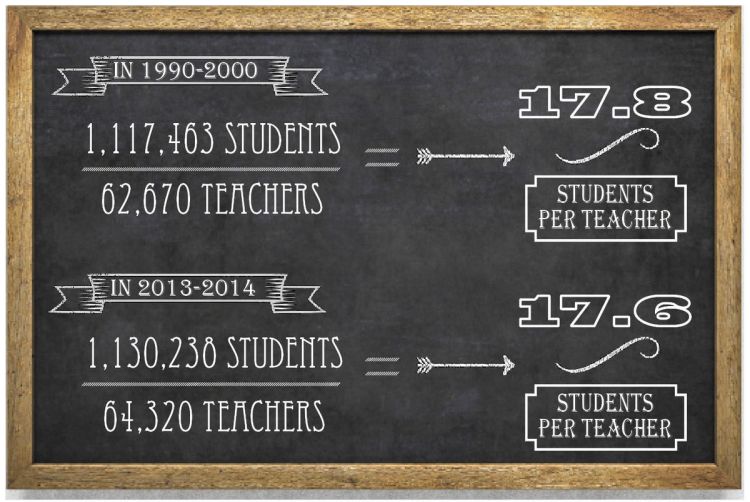
In the past 15 years, the number of teachers in Indiana has actually increased by 2.6 percent, compared to student enrollment that grew by 1.1 percent, according to data from the Bureau of Labor Statistics and the Indiana Department of Education. That includes K-12 public and private school teachers and students.

The idea of a teacher shortage spawned mainly from the declining number of initial teacher licenses issued in Indiana in the past five years – which dropped by 35.6 percent from the 2010-11 school year to the 2014-15 school year, according to data from the IDOE. The total number of teachers across the state dropped by almost 16 percent from 2009-10 to 2013-14.

Educators and state Superintendent of Public Instruction Glenda Ritz have interpreted that drop-off as reason to be alarmed about the future of the profession. Ritz continues to meet with a 49-person commission of educators, lawmakers and other stakeholders she assembled to delve into issues related to teacher retention and recruitment. A couple of weeks ago, a legislative study committee offered its recommendations for addressing the teacher shortage, which lawmakers can choose to act on when the next session convenes in January.

The idea of an impending teacher shortage has been used as a springboard to discuss what can be done to attract more people to profession – like raising pay or taking a step back from the increasing emphasis placed on student test data to measure their proficiency, as well as teachers’ performance.

“I think what’s really unfortunate over the last several years comes back to the perception of the teaching profession,” said Mike Sargent, assistant superintendent for Kokomo School Corp. “These are degreed, licensed, highly educated and highly trained people across the state who work really hard with children, and it’s really disconcerting to read and hear about the shift away from respecting those people who really give their life to a profession and work extremely hard for the betterment of our future.”

That negative perception, combined with the stress teachers are under related to standardized assessments, evaluations and state-mandated compensation models, all contribute to the teacher shortage, Sargent said.

If the downward trend in teacher licenses issued continues and fewer people pursue teaching, that would be problematic for schools. But it may be too soon to call it a teacher shortage.

Economists – including Michael Hicks, director of Ball State University’s Center for Business and Economic Research – have a different interpretation of data on Indiana’s teaching force. They see the recent decline in new teachers entering the field as a natural swing in the labor market, spurred on by the fact that just over half of people nationwide with education degrees actually end up in the classroom. Local school administrators say they used to get anywhere from 100 to 200 applications for an open elementary teaching position, though that number dropped drastically going into this school year.

“There’s just zero evidence there’s actually a teacher shortage.”


“There’s just zero evidence there’s actually a teacher shortage,” said Hicks, who has a PhD. in economics and released a study on Oct. 26 about Indiana’s demand and supply issues for K-12 teachers.

Defining a shortage

In economic terms, a shortage is when the demand for a position or product exceeds the supply. That’s simply not happening across the state with teachers, though smaller school districts especially may have had difficulty hiring for certain positions going into this school year.

As Hicks points out in his study, approximately 58.5 percent of all education graduates in the country were working in education as of 2012, according to the U.S. Census Bureau. Another 24.7 percent of all education graduates are working in other fields that pay more than education, and 16.7 percent are working jobs that pay less than education.

Hicks thinks the declining enrollment in teacher colleges stems from those statistics.

“There’s some evidence that fewer people are enrolling in teaching colleges, but that could be explained because so few people with teaching degrees go into education,” he said. “Some of this [teacher shortage discussion] can be fear from teacher colleges.”

Hicks’ study also looked at trends in teacher turnover, student enrollment and teacher wages, debunking the theories that those factors are behind the alleged teacher shortage in Indiana.

“To some degree what’s puzzling to me … is there’s no fancy analysis anywhere [in his study on Indiana’s demand and supply for K-12 teachers],” he said. “It’s all readily accessible information.”

If there truly was a teacher shortage, the answer would be to raise salaries for teachers in order to attract more people to the profession, Hicks said, suggesting that may be why educators are perpetuating the idea of a teacher shortage.

But Teresa Meredith, president of the Indiana Teachers Association, says there’s no direct benefit for teachers to perpetuate the idea of a shortage. She hopes the discussion about the state of the teaching profession motivates lawmakers to change some policies that she sees as disparaging the profession.

“In other businesses, a shortage may be a good thing because you can bargain for higher pay or better working conditions. But in teaching, you can’t do that.”


“It’s good to bring the conversation forward of what’s going on, what’s causing this,” Meredith said. “In other businesses, a shortage may be a good thing because you can bargain for higher pay or better working conditions. But in teaching, you can’t do that. That’s not how it works in teaching. Everything hinges on the political decisions.”

Meredith says the drop in applicants for open teaching positions across the state is a sign of a teacher shortage – something local administrators have echoed.

People may still be earning teaching degrees and getting licensed, but if they don’t end up in education, that’s part of the shortage, Meredith said.

“If there aren’t people applying for jobs, then yes there is [a shortage],” she added. “Even if folks have the degrees and aren’t using them, we need to figure out why.”  

Indiana teachers prepared by subject area

‘A skills mismatch’

The Indiana Department of Education defines a teacher shortage a little differently than economists would. States have the opportunity to submit Teacher Shortage Area proposals to the U.S. Department of Education each year, and if approved, teachers in those shortage areas may be eligible for some federal student loan forgiveness.

For the 2015-16 school year, the U.S. Department of Education designated teacher shortages in Indiana in career and technical education, business, various special education positions, early childhood education, English as a second language, math, technology education, world languages and all areas of science.

The number of shortage areas for the current school year is down from the 2010-11 school year, when 18 teacher shortage areas were recognized in Indiana. Three times in the past 25 years Indiana didn’t submit a proposal for any shortage areas.

The IDOE was not able to provide more specifics on how the state defines a teacher shortage area as of press deadline, but generally it’s based on the number of unfilled positions, positions filled by emergency certifications and positions filled by teachers certified in subjects other than what they are currently teaching.

Hicks thinks those teacher shortage areas are a result of a “skills mismatch,” where fewer teachers go into specialized fields, perhaps because they have more opportunities to earn higher salaries in other professions.

For example, local administrators have said it’s especially hard to hire for special education, foreign languages, science and math positions. Looking at those subject areas combined, only 16 percent of Indiana’s new teachers prepared in the 2012-13 school year were certified in those hard-to-hire areas, according to the most recent federal Title 2 data gathered under the Higher Education Act. By comparison, 28 percent of those new teachers were certified in elementary education, which is not of one of Indiana’s teacher shortage areas.

Hicks says a lack of qualified candidates in certain subject areas doesn’t equate to an overall teacher shortage.

“But I go back to why would that be the case [of shortages in certain areas]? I think the reason is teacher contracts don’t differentiate between job skills,” Hicks said, adding it could be beneficial to offer more compensation for teachers in those hard-to-hire fields. “I don’t assume people go into early childhood education because it’s easier. I don’t think it is easier. But we aren’t compensated on how easy or hard our job is. It’s based on supply and demand.”

This piece took first place for best news coverage with no deadline pressure in the 2016 Hoosier State Press Associations. Find other components of this package here.

Woman’s death calls into question 911 dispatch practices (Kokomo Tribune)

Kokomo firefighters took 13 minutes to respond to a medical emergency happening less than one mile from the station on July 1, after Howard County 911 Communications dispatchers sent them to the wrong address.

In the meantime, the woman who made the 911 call because she was having difficulty breathing died.

Firefighter Kurtis Reed, who was the officer in charge on the run, thinks the time spent going to the wrong address was a factor in the death of Tammy L. Ford, 50, who was pronounced dead at St. Vincent Kokomo at 2:31 a.m. July 1. Howard County Coroner Jay Price is still investigating the cause of her death.

“I believe that the difference in time being sent to the wrong address played a big part in [Ford] not making it,” wrote Reed, a 15-year veteran firefighter, in a run report obtained by the Kokomo Tribune.

Howard County Sheriff Department 911 Communications Center director Gary Bates acknowledges the tragedy of the situation, but he could not comment further on the response to Ford’s call specifically because the HCSD is investigating the incident in preparation for potential litigation.

“It’s tragic. It’s sad. We don’t want to make any mistakes. That dispatcher is going to have to live with that,” Bates said, noting Howard County’s dispatch responded to more than 220,000 calls in 2014. “Everybody makes mistakes. We try to catch those. … But one’s too many. We don’t want anything to occur like that.”

Fire Chief Nick Glover doesn’t want to speculate on the cause of Ford’s death and whether responding more quickly would have made a difference, but he did say there have been ongoing issues with Howard County’s 911 dispatch relaying correct information to the fire department.

“They do have some very good dispatchers over there who have been there a long time and take pride in their job and take it very seriously,” Glover said. “But it seems like there’s another group that has kind of adopted that ‘oh well, things happen’ attitude.”

Bates said any complaints – whether made by a citizen or officer – are thoroughly investigated, and the communications center will issue a finding.

“When we find those mistakes and it is a valid mistake by the dispatcher, we take the disciplinary action that has to be taken,” he said. “We don’t ever just blow them off.”

Ford called 911 at 1:41 a.m. on July 1 from her fourth-floor apartment at Terrace Towers, 600 block of South Bell Street, and a dispatcher notified first responders at 1:45 a.m., according to a Computer Aided Dispatch report from the 911 Communications Center.

“Howard County 911, where’s your emergency?” a dispatcher answers on an audio recording of Ford’s call.

“Terrace Towers,” Ford answers, and then gives her apartment number when the dispatcher asks “Where at in Terrace Towers?”

“What’s your problem?” the dispatcher asks, and Ford answers that she can’t breathe.

Then a second dispatcher comes on to ask Ford’s name, phone number, whether anybody is there with her and if she can let the officers in when they get there. Ford answers the questions, though obviously struggling to breathe.

“OK, I’ll get somebody on the way, OK?” said the second dispatcher, ending the 1-minute-15-second call.

The dispatcher then mistakenly sent a truck from Fire Station No. 1, 215 W. Superior St., and an ambulance from St. Vincent Kokomo to Civic Center Tower apartments, 200 block of East Taylor Street. The firefighters arrived first and found the apartment numbers didn’t match what dispatch had relayed, so Reed called the dispatch center to check the address. Medics arrived at Civic Center Towers before the error was realized, and they then followed the fire truck to the correct apartment building.

At 1:54 a.m. the location of the emergency is updated in the CAD report, and the firefighters arrive at Terrace Towers at 1:58 a.m., 13 minutes after being dispatched and 17 minutes after Ford called 911. The report says Ford did not have a pulse when the firefighters and medics found her, and she was transported to St. Vincent Kokomo before being pronounced dead. The Kokomo Tribune was not able to contact Ford’s family members as of press deadline.

“We work in a very serious field, and a lot of times seconds make the difference, whether it’s a fire or a medical call or whatever the situation,” Glover said. “Other than the obvious consequences for the citizens or the caller or the victim – whatever the case may be – there’s an impact on our people with the service they provide. They do take great pride and professionalism in what they do. It reflects poorly on them and it also is a burden they have to carry now, personally, of ‘maybe we could have helped this person if we had been there sooner.’”

Dispatchers followed the protocol as Bates explained it.

“When we take any type of medical call, our most important thing is location. Then we ask the person are they conscious and are they breathing,” Bates said, adding that information can tell the dispatcher what type of response is needed. “After that’s determined, we try to get a call-back number. Then, after the call-back number, we try to get their name.”

Dispatchers can stay on the line with the caller if other calls are not coming in. The Howard County 911 Communications Center fields calls for city police, city firefighters, county officers and county firefighters as well as answering 911 calls and administrative calls for the Kokomo Police Department outside of its office hours.

Between four and six dispatchers are working at a time, each operating a console with six different screens that show radio channels, a map that will zero in on where an incident is occurring, the CAD system that records the types of calls being answered and responses dispatched, a site to look up warrants, a query system to run license plates for officers and a screen that shows calls coming in on eight 911 lines. Dispatchers may have to multi-task and respond to more than one call at a time.

“It’s very easy to ‘Monday morning quarterback’ and say, ‘How could they ever make a mistake like this?’” Bates said, noting that dispatchers go through 480 hours of console training before becoming certified. “It’s not that hard to do. It’s tragic, but it’s not that hard to do.”

However, Glover said the incorrect address given for Ford’s call was not an isolated incident.

In addition to sending trucks to the wrong addresses, Glover said there have been other issues in working with the dispatch center, such as recommending trucks from stations that are not closest to the emergency and not sending the rescue truck to situations that warrant the additional aid.

“We’ve had to do some things on our end to fix the mistakes,” Glover said. “We can only go where they send us.”

Sending vehicles from a station that is not closest to the emergency may be a repercussion of the communication center’s new software, which staff implemented in December, Bates said. Information about the layout of Kokomo and all of Howard County, as well as each station’s boundaries, has to be entered into the software, which connects online to a server in Indianapolis.

Staff developed a total of 35 recommendations for what vehicles to dispatch depending on the scenario and location of an incident. There were some “growing pains” with that, Bates said, and if the system goes down for any reason, it’s up to the dispatcher to remember those recommendations.

“It’s such a complicated process making sure the right engines are going based on the boundaries,” Bates said. “Just one little checked box can make the biggest difference in the world. We try to make it the best we can. It’s growing pains and it’s something you just have to deal with.”

To correct the issue of sending trucks from the wrong station, the Kokomo Fire Department has changed how runs are broadcast on its audible paging system. Previously, only the station called on to respond would hear the dispatch information.

“We had to switch that to where all the runs are now dispatched at all the stations so that we can make the corrections and send the proper truck,” Glover explained, adding the change was made months ago.

The fire department also changed the procedure for utilizing its sole rescue truck, which has additional equipment to be used in more serious situations. Because the rescue truck needs to be available to respond to structure fires, the department had requested it be dispatched only to serious accidents. But with dispatch failing to send the rescue truck every time it was needed, the fire department is now having the rescue truck respond to all personal injury accidents in case it’s a serious wreck.

“If there was a vehicle that hit a dump truck or a building or in the water, then we would send the rescue truck also,” Glover said. “We had a lot of issues with [dispatchers] not doing that, so just last week we changed it to if there’s any wreck now we’ll send that truck.”

Bates said sometimes dispatchers are not provided complete information about an accident, so they may not know a rescue truck is required – like in cases where someone is trapped in a vehicle or the vehicle flips.

“If you listen to the 911 call and the dispatcher doesn’t get that there’s entrapment, if the people don’t tell us that information – how do we know?” he said. “If it works better for them to go ahead and send a rescue and then call it off, then that’s better.”


Follow-up reporting included:

KPD emails reveal long-running concerns with dispatch, published July 24, 2015

911 dispatchers discuss challenges of job, published Aug. 1, 2015

Concerns about Howard County dispatch being addressed, published Oct. 11, 2015

This piece and subsequent reporting took first place in best ongoing news coverage in the 2016 Hoosier State Press Association awards and was a finalist for Story of the Year.

A fine line between church and state: Eastern Howard School Corp. acknowledges Christian influence within public school district (Kokomo Tribune)

Eastern
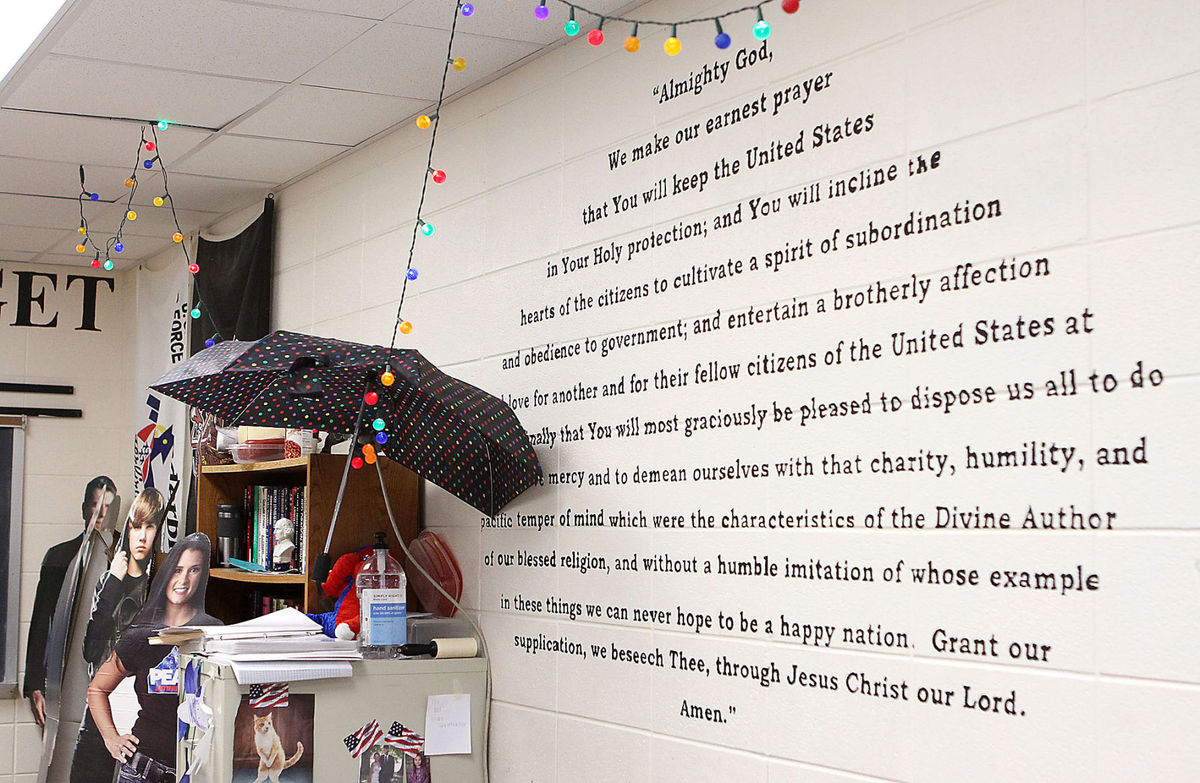
A quote attributed to George Washington adorns a wall of Peter Heck’s classroom at Eastern High School. Kelly Lafferty Gerber | Kokomo Tribune

Eastern Howard School Corp. acknowledges Christian influence within public school district

GREENTOWN – It’s there in the group of student athletes gathered before school each Wednesday to read the Bible together. It shows up when the elementary school student of the month is recognized for his “strong personal faith” as well as his classroom performance. It’s in the prayers before school board meetings, beginning-of-the-year staff meetings and choir performances.

The Christian influence at Eastern Howard School Corp. shows up in a variety of ways among administrators, staff and students.

“We are a community of Christians who also are teachers and educators, and I don’t think any of us leave our faith at the door because the bell rings,” said Eastern Schools Superintendent Tracy Caddell. “But by the same token, we’re not teaching doctrine. We’re teaching kids, hopefully, to love thy neighbor as thyself.”

As a public school, Eastern is prohibited from endorsing or practicing a specific religion, and for the most part, Eastern employees walk that line. Sometimes, they cross it.


“We are a community of Christians who also are teachers and educators, and I don’t think any of us leave our faith at the door.”


This is a school district that serves 1,465 students embedded in the predominately Christian community of Greentown, population 2,400. Most students are not only comfortable with school staff expressing their personal faith in a professional capacity, but they appreciate it. The school’s values are very much a reflection of the broader community, and if no one challenges whether the school district’s approach is constitutional, it’s possible for personal faith to be incorporated in a public school.

Religion in public schools

Ken Falk, legal director for the American Civil Liberties Union of Indiana, says under no circumstances should religion and public education be comingled. It is unconstitutional.

“A public school should have no role in promoting religion,” Falk said. “This is an area where the law is very clear.”

The national American Civil Liberties Union addressed the issue of religion in public schools in a joint statement that offers a summary of current law and Supreme Court decisions. The statement was published in 1995 and backed by 35 groups representing a variety of religious and political backgrounds

In general, the idea is that public schools can’t endorse any specific religion as part of their obligation to protect students’ rights to freely practice any religion they choose.

“The whole point about government and religion is you don’t want anyone to feel singled out,” Falk said, adding that children are especially susceptible to religious coercion because they don’t process varying belief systems the same way adults do.

Just because the majority of a community shares the same belief system doesn’t mean the school can promote those values, Falk emphasized.

“There may be people in the community who do not believe the same thing, but you’ll never hear from them because [the students] and their parents don’t feel they can speak up,” he said.

Eastern HS History Topics
Danielle Reed follows along on her iPad as another classmate reads from the Book of Judges in Eastern High School’s History Topics class on January 29, 2015. Kelly Lafferty Gerber | Kokomo Tribune

Faith doesn’t end with the school bell

Caddell is quick to acknowledge the Christian influence throughout his district. He underscores that it’s a matter of teachers and staff living out their beliefs and modeling positive values for students, rather than preaching or promoting a certain doctrine.

“Jesus Christ is my Lord and Savior and that doesn’t stop just because the school bell rings,” Caddell said. “As a leader, I’m hoping that we’re promoting what people would call Christian values. However, we’re not promoting or teaching Christian doctrine. There’s a big difference.”

Some of the Christian values Caddell hopes are evident among staff include compassion, joy, peace, patience, kindness, self-control and love.

“I’m a firm believer that we’re more than just teaching kids about English and math,” he said. “We’re teaching kids about building peaceful, healthy relationships. If we as teachers and educators and superintendents – and Christians – can model those behaviors, I think that’s a big positive.”

In addition to the moral code Eastern staff model for students, the school corporation also offers more structured means for Christian values to become a part of the school culture. Eastern Elementary School teaches character education, Eastern Jr./Sr. High School hosts a Fellowship of Christian Athletes student club and students organize an annual See You At The Pole prayer event. Also, high school students can elect to take a History Topics class that teaches the Bible as literature.

Area churches also are involved with the schools. Jerome Christian Church in Greentown partners with the elementary school to offer a Kids Hope mentoring program. Oakbrook Church in Kokomo ran Eastern’s character education program before school counselor Gina Stahl took it over. First United Methodist Church of Greentown helps with the school’s Buddy Bags program through Kokomo Urban Outreach to send food home for the weekend with kids in need. Eastern students and staff also participate in a variety of community outreach activities, which are highlighted each month through the corporation’s new Eastern Cares initiative.

“There are different churches that have been involved in helping us with our mission of helping and supporting kids. None of these groups have ever come in and tried to force their doctrine on the school, that’s for sure,” Caddell said. “They’re not here to teach doctrine to the kids. They’re here to show them there are adults who care for you.”

Walking the line

“Then the Lord raised up judges, who saved them out of the hands of these raiders,” an Eastern High School student read from Judges 2:16 at the request of his teacher during class one morning in January.

It may come as a surprise to know the Bible is read during class at a public school, but it’s protected by the Constitution in the context of Peter Heck’s History Topics class at EHS. The history of religion, comparative religion and any religious text-as-literature are acceptable public school courses, the ACLU’s joint statement advises.


“The entire premise of the course is that an educated person knows the Bible.”


“The entire premise of the course is that an educated person knows the Bible,” said Heck, who is an Eastern graduate and has taught in the district for 12 years. “If we were graduating students from Eastern – or from any school – who were unable to do basic addition or subtraction, everybody would flip out about that. … And yet, we continually in this country and in this state are graduating high school students who don’t have any fundamental basis of understanding the Bible.

“That is the basis of Western civilization, so I’m curious as to why there isn’t outrage at how we can have young people going off to college who don’t have any concept or any understanding of a group of documents that provided the basis of everything we see around us [like art, literature, government and ethics],” Heck continued.

His lesson on Judges that day focused on how God used unexpected people to do something profound, and Heck went over the pattern of life for the Israelites during that period in history. Then students were assigned to identify unique characteristics of each judges’ rule.

EHS began offering History Topics in 2012, and it has been popular among students, with 30 to 35 signing up for the elective social studies course each semester. This school year, 60 students signed up for it, so Eastern adopted a blended learning model where Heck simultaneously teaches two sections of the class; half the students come to school for class one day and then the other half comes the next day, and students complete digital learning from home on the days they’re not required to be in class.

“Maybe there’s a little bit of novelty to it that it’s something different. For some students who are church goers, they may have the impression that this will be an easy A,” Heck said of students’ interest. “Probably, curiosity may be the most profound factor.”

Likely another reason for the class’ popularity is Heck’s sense of humor and his repertoire with the students. It’s easy to see why they enjoy the laid-back atmosphere of the class and the chance to joke with Heck as he teaches.

“He’s just an awesome teacher,” said senior Jenny Keith. “People enjoy having him, so they take whatever chance they can get to have [a class with] him.”

Outside of school hours, Heck hosts a conservative radio talk show, “The Peter Heck Radio Show,” where he discusses politics “through the lens of Christianity.” In the decade Heck has hosted various radio shows, he’s been outspoken about his views opposing gay rights, abortion and President Barack Obama’s “defense of radical Islam,” to name a few of the recent topics discussed on his show.

But none of that comes into the classroom, Heck says.

“I will say the school has been very good about allowing me the freedom of speech and to have a career outside the classroom,” Heck said. “They’ve simply requested, and I’ve assured them many times, that what I do here [in the classroom] is distinctly different from what I do there [on the radio show].”

Eastern HS History Topics
Nathan Everett (left) and Evan Rodgers work together on an assignment to summarize the different judges from the Book of Judges in Eastern High School’s History Topics class. January 29, 2015. Kelly Lafferty Gerber | Kokomo TribuneKelly Lafferty Gerber

Many of his students are aware he hosts a radio show, Heck said, but it’s not something about which they are likely to have a conversation. He doesn’t think many high school students are interested in the political issues he discusses on his show.

“Especially doing a program like that in my outside-of-school career, it makes me even more cautious because I know there are those who will say, ‘There is no way he can be that way outside of school and keep those biases out of what he does in the classroom,’” Heck said. “It’s almost as though there’s a keener microscope on me because of it, so I’m conscious of it and I want to do a very effective job of not crossing that line.”

Another teacher, Karol Evenson, takes a different approach to mingling her faith and her professional role. Evenson has been the choir teacher at Eastern Jr./Sr. High School for 31 years. She grew up in a Christian family that was very active in their church, and she holds those same values today. Evenson says she carries her faith into the classroom as a natural extension of herself, and she was moved to the point of tears to hear that her students took notice of that.


“It’s just who I am, so I’m not going to deny it and if I have an opportunity where I’m going to share it, I’m going to.”


“It’s a very big part of my life so how can I teach and it not be a part of my teaching?” she said. “It’s just who I am, so I’m not going to deny it and if I have an opportunity where I’m going to share it, I’m going to.”

However, teachers and administrators, when acting in those capacities, are representatives of the state, the ACLU specifies. They are prohibited from encouraging or soliciting student religious or anti-religious activities, and they may not engage in religious activities with their students.

The main example Evenson gave of an opportunity for her to combine her faith with school events is the school’s annual Christmas program, which includes a Nativity re-enactment featuring faculty members. Students also sing secular and religious Christmas songs during the program, which draws a crowd big enough to fill Eastern’s  Performing Arts Center each year, Evenson said.

“That is one major thing that’s done at Christmas time where we are singing about the birth of Christ,” she said. “I just get real passionate about that when I’m teaching it, so it allows me to share things. A lot of times, I tell the kids, ‘I’m not asking you to believe, I’m hoping that you do and that you will, but I’m trying to get you to feel the music and what we’re singing about.’ A lot of the kids here do believe it, so when they are singing those pieces, it’s such a blessing for me.”

Falk said the Nativity should not be part of a public school event. Public schools may teach objectively about religious holidays and may celebrate secular holidays, but it is unconstitutional to observe holidays as religious events at a public school.

Evenson gives students the option not to participate in the religious aspects of the Christmas program, and she said one or two students in her three decades of teaching have taken advantage of that option. She also allows students to step aside when she prays with students before every choir show.

“I tell them if they don’t want to do that, they can step into the hallway,” Evenson said. “Before a concert or a show that we do, we always stand in a circle and pray. Most times I lead it, … and sometimes a student will step up to do it.”

Evenson said she has never gotten the sense that some students were not comfortable with the prayer but stayed in the group just to avoid singling themselves out.

“I’ve never had a parent call me and complain that we’d done that,” she added. “I feel like if it had made their child that uncomfortable, they would tell their parent and the parent would be calling me.”

Caddell is glad staff and students feel empowered to share their faith at school.

“I think it’s important to remember that you don’t give up your faith because the school bell rings. I think kids need to know that, I think teachers need to know that and staff,” Caddell said. “Over time, we’ve gotten so worried about political correctness in this country that people have not had the opportunity to feel comfortable being a Christian in a public school. I think that’s sad, because that’s who you are.”

Eastern HS History Topics
Peter Heck teaches History Topics, an elective at Eastern High School that talks about the Bible’s historical influence. Kelly Lafferty Gerber | Kokomo TribuneKelly Lafferty Gerber

What do the students think?

In various ways, students also express their faith at school, which is protected by the Constitution.

The most prominent way may be through the high school’s Fellowship of Christian Athletes, which is part of a national network of athletes and coaches committed to making an impact for Christ.

There are about 30 high school students involved in the club that meets every Wednesday before school for breakfast and a devotional. Junior high students started their own chapter of the club this school year, too. There are about 700 students total in Eastern’s Jr./Sr. high school.

“It’s a way to show leadership and it’s time spent with God in the mornings with a group of people,” said Megan Dean, a senior who plays tennis and is involved in FCA.

The group organizes Eastern’s See You At The Pole event, which drew about 40 people to pray before school one morning. It also participated in the Kokomo Rescue Mission’s Yes We Can canned food drive and hosts other activities for club members. Religious clubs, as required by the Equal Access Act, must be granted the same opportunities as any other student group at a public school.

Several members of the FCA said they think many of their peers are Christians, but they don’t see religion is a dividing point at the school. Dean said it’s more common for Eastern students to identify as Christian than not.

“At least for me, I have a lot of friends who aren’t Christians here,” added senior Courtney Clark, a member of FCA. “The community at Eastern is amazing. Pretty much everyone gets along. I don’t ever really see discrimination of anyone. Religion isn’t a big deal for friends here. A lot of us have friends with different religions, so I wouldn’t say they would feel alienated ever or like there’s a barrier.”

Students also know many of their teachers are Christians. They said it’s apparent in the way teachers try to build relationships with students, and Evenson said students will come to her when there’s something going on in their lives they would like her to pray about.

“They also teach a lot of moral standards, where you can just tell it’s coming from a Christian background,” Clark said. “Not in a way that they force it on us, but you can just tell that they are.”

Senior Sam Rocchio, also a member of FCA, thinks the Christian influence in Eastern’s school culture is apparent to those who share the same belief system, but it doesn’t alienate others.

“Being a Christian, you can see the environment and you can feel it around you and you just know,” he said, adding students see teachers outside of school at church events sometimes. “It wouldn’t be a surprise to say there’s a good amount of the population that’s probably not [Christian]. This is a public school; it’s not like we’re Christian based.”

At the elementary level, there are no organized religious clubs. The closest students may come to a time in their school day set aside for religious purposes would be the moment of silence held each morning after the Pledge of Allegiance.

“Some of them don’t know what to do during a moment of silence, so I tell them if you’re thinking of a family member today, that’s a good time to do it,” said Eastern Elementary School teacher Randy Maurer. “If you’re wanting to plan for your day, you can think of the things you need to accomplish, and I always say, if you’re the type who likes to pray that’s a time to say a prayer if you want. Or you can think about something that happened on the way to school.”

The junior/senior high school also holds a moment of silence each day; assistant principal Brad Fuggett said the moment has never been specifically explained to students because they have grown up with it in elementary school. The Supreme Court ruled in a 1985 case out of Alabama that schools can hold a moment of silence as a chance for students to pray voluntarily if they choose, but it is unconstitutional to designate a moment of silence in school specifically for prayer.

A reflection of the community

Many school staff members say the culture at Eastern is an extension of the attitudes that permeate all of Greentown, which is home to seven Christian churches. But even if the majority of the community shares the same faith, one can’t draw the conclusion that every Greentown resident or person affiliated with Eastern Schools is a Christian.


“We are a small Greentown community that is a predominately Christian community, and I would assume those values would be expressed through the school.”


“We are a small Greentown community that is a predominately Christian community, and I would assume those values would be expressed through the school,” Caddell said, adding the school corporation’s value system was established well before he started as superintendent there.

He said he has not heard from a family who was put off by the school culture at Eastern.

“I’ve not had that happen,” Caddell said. “I mean really, what is a parent going to say – that we want you to love my child less or show them less compassion?

“I’ve had people tell me that Eastern’s about as close to a private school as you can get and still be a public school,” he added, saying he believes that stems from the moral values displayed within the schools. “I’ve had lots of teachers and staff members tell me that Eastern’s just a different place. It’s nice to have people care about you.”

Working at Eastern has been a blessing, Caddell said, because it ties into his values. His co-workers have strengthened his faith, and their support especially meant a lot to him last April as he recovered from a stroke.

Evenson also feels blessed to work at the school corporation.

“I’m thrilled that I have taught in a school system like this. I think there is a reason that I got put here,” she said, choking up with emotion again. “This community is very Christian-based, and the kids are very involved with their faith. It does make it easier to open up and talk about things like that because you have more support in the community.”

Heck and Maurer said they feel Eastern provides an environment where people feel comfortable expressing their faith, but are not forced to adopt a certain belief system.

“I think Eastern reflects the values of the Greentown community. There are a number of excellent churches in this area,” Heck said. “I would say a very large percentage of our student body and families represented here are Christian. Many of my colleagues are Christians, and some of them aren’t. But everyone I know promotes Christian values in the sense that they’re not preaching Jesus, but they’re living Jesus. … That’s the form Eastern’s Christian values take.”


Follow up reporting included concerns raised by the Freedom From Religion Foundation (here), and the school corporation’s response to those concerns (here). 

Teaching Success: Bouncing back from ‘ineffective’ (Big Rapids Pioneer)

Ex-teacher shares circumstances that prompted her to leave the classroom

Katie Tomczyk gave her all in her first year of teaching, loving the chance to make a difference in students’ lives.

Five years later, that passion was gone. So she quit.

“I saw the effort and commitment in other teachers,” said Tomczyk, 29, a Big Rapids native who now lives in Traverse City. “I said ‘I’m not there, and (the students) deserve the best. If I can’t give them the best, I shouldn’t be teaching.’”

After leaving her Big Rapids Middle School classroom behind at the end of the 2011-12 school year, Tomczyk has spent the past year teaching fitness classes in Traverse City. Her love for students has led her to a support staff position assisting a girl with Down syndrome at The Children’s House, a Montessori school in Traverse City, for the 2013-14 school year.

“I took a break, but I’m coming back,” Tomczyk said, noting the various phases of her career path, from a charter school to an ISD-run program to traditional public school and now a Montessori school. “I value making a difference in the students’ lives and trying to get to know kids individually.”

Teaching SuccessCircumstances in Tomczyk’s personal life diminished her passion for teaching and led her away from the profession before she was dismissed for being “ineffective.” In 2011, Michigan reformed its teacher tenure law to make it easier to remove low-performing teachers from the classroom.

Teachers with the least seniority are no longer the first laid off; instead, the teachers with lower evaluations are the first let go. The length of time it takes teachers to qualify for tenure was increased from four years to five years, although a teacher who is rated “highly effective” for three years can achieve tenure status more quickly.

Once teachers have earned tenure, they still must be evaluated as “effective” in order to keep that status. Three consecutive years of “ineffective” ratings are grounds for termination, and the Michigan Council for Educator Effectiveness has recommended that timeline be shortened to two consecutive “ineffective” ratings.

Tim Webster, superintendent of Reed City Area Public Schools, said the higher standards for tenure and higher-stakes evaluations have teachers more focused on improvement.

“When you sit them down to talk about some things (they’re) having trouble with, I think the teachers are listening much more closely than they’ve ever listened before,” said Webster, who served as Reed City Middle School principal for 17 years before accepting a new role as superintendent for the 2013-14 school year. “They know the new process is out there, and as a result, they’re very willing to work. We definitely have the attention of the teachers, who, I suppose, in the past could have said ‘I’m at least average or better, so it’s really going to be hard for them to get rid of me.’”

Teaching through adversity

Tomczyk’s evaluations reflected a slip in her performance, and she voluntarily made the decision to quit teaching rather than coast along in the profession.

She graduated from Big Rapids High School in 2002 and went on to earn a degree in learning disabilities from Hope College in 2006. In her summers during college, Tomczyk worked at SpringHill Camp in Evart as a counselor for children with and without disabilities. Her experiences there solidified her decision to go into teaching.

“I liked the blend of working with children with and without disabilities,” she said, noting the benefits of working outdoors and engaging children in hands-on activities. “I think it promoted that we all have different strengths and weaknesses and can support each other. By the end of the week at camp, I could see the campers growing in character and understanding.”

CLASS TIME: Riverview Elementary School students work on a coloring activity. Teachers who cannot form a personal connection with their students will struggle to be rated “effective.” (Pioneer photo/Lauren Fitch)

After earning her degree, Tomczyk was hired at Crossroads Charter Academy in 2006, where she taught for one school year. She then spent three years teaching at the Mecosta-Osceola Intermediate School District Education Center, working with a class of fewer than 12 students with severe cognitive impairments. Big Rapids Public Schools hired Tomczyk to teach at the middle school in 2010, where she stayed for two years as a sixth-grade resource room teacher.

“Being a teacher is a lifestyle. … You should go in every morning like ‘Wow, I get to work with kids. I have an impact on their lives.’ If you don’t get nervous about that, then I don’t think you should be a teacher,” she said. “When I got my first teaching job at the charter school, I made that my life. I spent every Saturday morning planning my lessons. I loved it. That was my favorite year of teaching.”

While Tomczyk would have been happy to continue teaching at Crossroads after that first year, events in her life beyond the classroom prompted her to move on.

Her boyfriend of five years, Brian, had brain cancer. The MOISD offered better health benefits than the charter school, so Tomczyk sought a job there. She and Brian were married in June 2008, and he passed away that November.

Tomczyk struggled to teach through her grief.

“I believe Brian’s care added to my fervor and energy to pour out to students,” Tomczyk said. “A couple years after Brian died, a job opened at BRMS. I thought it would be a good opportunity to do what I went to college for. … I loved the community, I loved the kids. I wanted to be a good teacher, and I was getting paid good money. I felt some hesitation about teaching, but I figured it was my first year in that setting, so I should try a second year.”

But as her second year at BRMS wore on, Tomczyk realized teaching didn’t make her happy anymore. Seeing other teachers who were dedicated to their jobs made her feel guilty, and she began to withdraw from her co-workers and put minimal effort into lesson planning.

At Crossroads, Tomczyk received high ratings, and her “effective” performance continued at the MOISD Education Center. At BRMS, Tomczyk started to struggle, and principal Lenore Weaver gave her an “ineffective” review after her first observation during Tomczyk’s second year teaching there.

Tomczyk respected Weaver’s honesty and compassion during tough conversations about her sub-par lessons.

“She was very compassionate with me, saying ‘I see your heart, I see that you care. But something else is going on.’ She always was able to tell me the good and the bad together,” Tomczyk said. “It was embarrassing for me, and it was hard. But I also respect her because I thought it was good that she was holding me to that higher standard. I could have put more time and effort into planning.”

Individualized Development Plans

All six districts in the MOISD rated more than 95 percent of their teachers “highly effective” or “effective” in the 2011-12 school year, the most recent data available.

For the small percentage of teachers who fall into the “minimally effective” or “ineffective” range, there are several steps administrators must take to give the teachers time to improve. By 2015-16, Michigan schools will begin to classify teachers as “professional,” “provisional” or “ineffective” instead of the current four-tier system.

Low-ranking teachers are put on an Individualized Development Plan (IDP), which offers specific steps to improve areas of weakness and sets a timeline for when results should be evident. The plan includes expectations for the teacher as well as the administrator.

“To be rated ‘minimally effective’ or ‘ineffective,’ there’s some significant deficiencies that are affecting children’s learning,” Webster said. “A lot of times administrators want to be nice, and they don’t want to tell anybody, ‘You’re not doing a good job.’ But then you’ve got 100 kids who see that teacher, who aren’t getting the education they should get.”

Principals identify areas of weakness in a teacher’s instruction through observations required as part of teacher evaluations. It is important for principals to have concrete evidence of deficiencies when discussing them with teachers, Webster said. He also involves union representatives in constructing an IDP for a teacher. Part of the 2011 reform to Michigan’s teacher tenure laws was that unions no longer can bargain around the requirements for teacher evaluations.

“The union people are there to support their teachers,” Webster said. “In my opinion, the union is there to make sure teachers get a fair shake. So when I do an IDP, I invite them in to help me.”

Grading the teachers
Michigan teachers are given a rating based on their annual evaluations, which include classroom observations completed by the principal and student growth data. The ratings teachers can receive are: “highly effective,” “effective,” “minimally effective” and “ineffective.”
Each local school district decides the factors that will be included in teacher evaluations and the criteria attached to each rating. Michigan is moving toward a statewide evaluation system that will provide common evaluation criteria, based on a recommendation from the Michigan Council for Educator Effectiveness.
The MCEE suggested teachers be rated as “professional,” “provisional” or “ineffective.” The council believes the three-tier system will improve accuracy in rating teachers and encourages all teachers to continue to improve, rather than becoming complacent as “highly effective.”

One school year is the typical time frame for a teacher to fix problems raised in the IDP. Depending on which area a teacher is struggling with, there may be more urgency to show improvement.

“The most significant thing is classroom management,” Webster said. “If a teacher can’t manage a classroom, it doesn’t matter if they can do all the rest of that stuff. Even if you know your curriculum, even if you design great lessons, you’re on time to work every day, you dress nicely – but if you can’t manage your classroom and get the kids cooperating with you, then you can’t teach them anything.”

Education is a complex process to evaluate because so much of it hinges on the relationship between a teacher and the students, Webster said, advocating that some people have a natural ability to teach. Those without that ability can improve to a certain point, he said, but they are unlikely to reach “highly effective” status.

“There are people who are born to teach,” he said. “It’s the building relationships with kids, connecting with kids and making them feel important. If you don’t have the ability to do that, you won’t be a good teacher. And you can’t teach that. When you get to ‘minimally effective’ and ‘ineffective,’ those are the ones who don’t get the student connection part. Then there’s a lot of people in the middle.”

To reflect the importance of classroom management and student-teacher relationships, RCAPS recently reformatted its teacher evaluation system. Classroom management now carries the most weight in the evaluation, 32 percent, followed by student growth accounting for 25 percent, planning and preparation with 16 percent, instruction with 16 percent and professionalism at 11 percent.

RCAPS teachers receive an overall score with their evaluation, and all the teachers who score in a certain range will be rated “professional,” “provisional” or “ineffective.” Layoffs will be based on seniority starting at the lowest classification, which will give teachers more security than the district’s previous system did, Webster said.

“Now, if an administrator says a teacher is bad, that’s not even something to argue about,” Webster said, noting it was much more difficult for an administrator to prove a teacher was not performing well before the teacher tenure reform. “If the teacher disagrees with the evaluation … and they want to fight it, the teacher now has to prove the administrator is being arbitrary or capricious.”

“It used to be harder to get rid of bad teachers. Now it’s easier, and hopefully administrators don’t abuse that,” he added.

This is the second installment in a five-part series discussing the different aspects of successful teaching and how to identify and reward great teachers. This series took third place for best news enterprise reporting in the 2014 Michigan Press Association awards. 

Other parts of the series included: how to recognize A+ teachers and measure their success; whether merit pay is an effective way to motivate teachers; a panel of educators discussing issues related to reform of teacher tenure system and teacher evaluations; and a look at what teacher prep programs and principals say is the best way to prepare new teachers.

Earning a path out of poverty (Big Rapids Pioneer)

Area residents living in poverty discuss stigma, shame that comes with admitting they need help

Sometimes all you can do is put on some lipstick.

When utility shut-off notices and bills are piling up, you’ve been wearing the same clothes for days, all you’ve had to eat this week is peanut butter and jelly sandwiches and now you’ve got to choose between repairing your truck and buying Christmas presents for your grandchildren, the best you can do is put on a little lipstick.

That lipstick is a small gesture to make you feel even remotely a part of the world where people work 9-5 jobs, wear new clothes, drive working cars and have well-stocked pantries at home.

Poverty is isolating.

KNOWING YOUR WORTH: When faced with the stigma and shame that comes with poverty, Mecosta resident Zandrea Boss says it’s important to know your own worth. Boss has struggled with living in poverty her whole life. (Pioneer photo/Lauren Fitch)

“You have to know your own worth,” said Zandrea Boss, 52, who has struggled with living in poverty her whole life. “That time you spend feeling defeated is wasted. If you utilize what you already have, you’re going to get ahead.”

A weariness comes over the Mecosta resident as she talks. Life has challenged her in many ways, but it hasn’t broken her.

“Show them your beautiful scars ’cause they’re the proof,” Boss said, quoting a line from “Healing has Begun,” a song by Matthew West, as the reason she wants to speak out about poverty.

The Kaufman family, of Big Rapids, recently had a more short-term bout with poverty. Kurt, 48, was laid off from his job at Ford-Visteon in 2009 after almost 20 years as an employee there. His wife of 21 years, Sharon, lost her job the same year and the family of six lived on $1,200 a month from unemployment benefits for awhile – a drastic change from their former $80,000 a year household income.

Kurt qualified for Trade Adjustment Assistance, a federally-funded program that allows workers laid off as a result of foreign trade (like the auto industry) to continue receiving unemployment benefits as long as they are enrolled in continuing education or involved in other job search efforts. After a year at Macomb Community College, Kurt and his family relocated from their home in Canton to Big Rapids so he could finish his automotive engineering degree at Ferris State University.

He completed 44 credits in one year to graduate in August 2012, but with graduation came the end of his assistance through TAA. The Kaufman family found themselves applying for cash assistance through the Department of Human Services for the first time, in addition to the food assistance they’d been receiving since 2009.

“They cut us off from unemployment when he graduated. That’s when we went into the system of getting cash assistance,” said Sharon, 44. “From September to (January), basically we were living on $600 a month. In Canton we had our own home, we bought new cars – all that stuff. (Then) we went to living in government housing and driving 20-year-old cars. It made a big difference.”

CHANGING LIFESTYLES: The Kaufman family – (back row, from left to right) Kurt, Kris, Sharon, (front row) Kim, Phillip and Ashley – is pictured in 2008. They moved to Big Rapids in 2011 after Kurt and Sharon lost their jobs in the Detroit area. The family traded its $80,000 annual income for government assistance while Kurt completed a degree at Ferris State University and eventually got a new job. (Courtesy photo)

Three of the Kaufman’s four children – ages 10, 15, 17 and 21 – lived with them in Evergreen Village, a Big Rapids apartment complex run by the Housing Commission. Their food and cash benefits didn’t cover all their needs, so they turned to Project Starburst for extra assistance. Sharon also volunteered there. In January, Kurt was hired as a software analyst for John Deere in Cedar Springs, Iowa. The Kaufmans relocated early in February, and they are happy to be moving on to a brighter future.

Under the magnifying glass

Boss has not been able to move out of poverty so easily. She grew up in a low-income household in Fort Wayne, Ind. At age 15, she became homeless when she could no longer live with her mother. Boss eventually graduated from high school at age 21 and saw higher education as a tool to break the cycle of poverty. She earned a 4.0 GPA in the first two years of her undergraduate degree and then continued on to earn her master’s degree, both at Central Michigan University, graduating in 1989.

Over the years, she held various jobs as a counselor or social worker, but ultimately her physical disabilities – exacerbated by a car accident during college – prevented Boss from working full time. Raising two children with disabilities, caring for a long-term boyfriend who died of cancer in 2012 and dealing with her own health issues presented other stumbling blocks for Boss.

She still finds things to laugh about – amid the tears – as she talks about her experiences. Grieving is normal, Boss explained, poverty is not a death sentence and the important thing is to never stop fighting for your quality of life.

“I keep saying ‘I have a master’s degree, for God’s sake. I graduated cum laude.’ Why do I keep saying that?” she asked. “You still have to feel useful. I don’t want to feel like my (education) was in vain. Just because I’m not working 40 hours a week anymore doesn’t mean I’m not contributing to society.”

Poverty is a label that’s difficult to shake, Boss said. The shame that comes along with that label is what defeats many people.

“It’s very intimidating when you have to talk to (case workers) and they have expectations of you that you can’t meet,” she said. “You feel small in every regard. … When you’ve got to go into (a service agency), all these people see you standing there. … If you’ve been going in there for 20 years, you feel like ‘yeah, I should have figured something out by now.’ They do get tired of seeing you come back year after year after year.”

Sharon also felt the discomfort of the “poverty label,” especially when she first started applying for assistance.

“When I first went in (to DHS), people would look at you like ‘What are you doing here?’ I felt like I was under the magnifying glass,” she said. “I didn’t look the part (in business casual attire). I’m usually business-minded, so when I go someplace I’m not going in jeans and a T-shirt. I stuck out a little bit. Then with the case workers, it’s like ‘you need to prove all of this to us.’ I understand I need to prove (our need), but it gets to the point of if I didn’t need (the assistance), I wouldn’t be here. I gave them everything they needed, and then I had to supply more.”

People applying for assistance must present documentation proving their identity, income, assets and expenses, said Kim Kilmer, assistance payments supervisor at Mecosta-Osceola DHS.

SEEKING ASSISTANCE: Department of Human Services employees guide clients to various resources. According to , more than 17,200 people in Mecosta and Osceola counties have qualified for some type of assistance each month in 2013. (Pioneer photo/Lauren Fitch)

“They have to look at DHS as a last resort after they’ve exhausted all their resources,” Kilmer said.

The nature of the system for qualifying for benefits prevents some people from trying to escape poverty, Boss and Kaufman agreed.

For example, if a person on assistance quits his or her job – for a reason not deemed as “good cause” – DHS will sanction the case and not provide that person with assistance for a period of time. The first sanction results in loss of all benefits for three months, the second is for six months and the third is for a lifetime. Clients must resubmit their application after a sanction.

For some people, that’s a reason not to “risk” employment; rather than find a job, have it not work out and end up with less assistance than before. Also a raise can lower the amount of assistance people qualify for – depending on the type of income – which makes it difficult for some to do anything but live paycheck to paycheck. DHS factors in only a certain percentage of earned income when calculating the benefits for which they qualify; unearned income, like disability payments, is factored in dollar for dollar and results in a more drastic reduction of benefits.

“People stay stuck because they’re not rewarding people for working.” Boss said. “If you try and you fail, the process begins again. You may end up in a worse position.”

Sharon and Kurt found they didn’t qualify for Medicaid after they lost their health insurance because Kurt’s $1,200 unemployment check was considered too much income. They also had difficulty meeting the rigorous requirements for receiving cash assistance.

“It’s frustrating,” Sharon said. “I understand that you have to spend 40 hours a week looking for a job, but you have to check in every day. If you’re a minute late, you can get a violation. It’s very tough, and I really understand how some people just say ‘I can’t do it.’”

Defining poverty

In 2012, the U.S. Census Bureau defined poverty as $23,283 for a household of two adults and two children under 18. In 2011, the most recent year for which Census data is available, 17.5 percent of Michigan residents were living in poverty. By comparison, the poverty rate was 17.6 in Osceola County and 25.6 in Mecosta County.

According to DHS, so far in fiscal year 2013, an average of 10,540 people in Mecosta County qualify for some type of assistance each month. In Osceola County, the monthly average is 6,729 people who qualify for assistance.

Poverty looks different for each person. Boss defined it as having to choose between necessities because you cannot afford all the things you need.

“I have some reservation about defining poverty because it comes in so many forms and is caused in so many ways,” she said. “I’d have to get a raise to get to poverty level – what are people like me who can’t even make it to poverty level?”

There is a feeling of judgment that comes with admitting you live in poverty, Boss said, and people have certain expectations for how people in poverty should look, act or live.

“I don’t think I fit the (stereotype) of poverty, because people don’t expect poor people to be educated. But how many of us graduated from college and didn’t get a job?” Boss said. “It doesn’t matter if you have a brand new car or a brand new house. If life took a turn and handed you the poverty bag, now you can’t apply for services until you sell your assets. Well, what do you eat while you’re selling your assets? So the woman who has a fur coat (is drawing benefits), maybe that’s her only coat. Should she not apply because she doesn’t look the part?”

A person’s mindset also has a lot to do with how they experience poverty, Boss said, adding there’s a difference in poverty-mindedness and living in poverty.

“A person with poverty-mindedness doesn’t believe there’s anything they can do,” she said. “Poverty-mindedness is thinking nothing’s going to matter. Hope is thinking everything I do is going to matter. In my mind, everything I do matters. You just do the next right thing.”

“People think people in poverty have a certain mentality of ‘I’m gonna work the system,” Boss added. “You better damn work the system! It’s a double-edged sword there. If they don’t work the system, they’re ‘not using their resources.’ So what is the correct answer for that? I certainly wouldn’t pretend to have it.”

The Kaufmans began to realize they were struggling financially in 2007 when Kurt was diagnosed with colon cancer. He went on disability leave for about 11 months, returned to work in 2008 and then was laid off in 2009. Sharon was working during Kurt’s disability leave so the family did not receive any state assistance, but money was tight and kept getting tighter after Kurt and Sharon lost their jobs.

When the family eventually moved from Canton, the bank repossessed their house.

“We have our regrets at times, but you know what? I think we’re happier now,” Sharon said. “It’s been a really big eye opener. We’ve learned a lot of lessons going from one extreme to the next. We’re realized new cars every two years aren’t important. You don’t to have to compete with the neighbors and what they have. … We’ve already committed to giving back (to local food pantries) for helping us.”

Explaining the family’s financial situation to their children was a difficult, tearful process, Sharon said. The youngest, Ashley, took it especially hard.

“Even after we moved up here, they still wanted to go hang out with their friends,” Sharon said. “It got to the point where we had to sit them down and say ‘We just don’t have the money. We’re really sorry.’”

When they had extra money, Ashley was able to go skating with her friends, but still she couldn’t afford to go as often as she would have liked.

She especially misses being able to play with her best friend, who lived right across the street from her at their home in Canton. It was during a snow day that Ashley reminisced about the snow forts she and her friend used to build together.

Ashley also urged people in more privileged situations not to take their circumstances for granted – something she’d recently learned from her parents.

“We have found ourselves with more family time,” Sharon said. “We made sure our kids understood they have everything they need. They may not have all their wants, but if we’re together as a family that’s the most important thing.”

Finding a way out

In 2003, Boss had to stop working full-time because of her physical limitations. She now spends her time caring for her family and trying to make ends meet.

“You have to re-invent yourself,” she said. “I’ve been a caretaker. Life keeps looking like a tornado every time I try to jump in. … I can’t help everybody else without having some support for myself. And I don’t have any, besides the agencies and professionals who help me.”

Eventually, Boss would like to extend support to others in crisis. Back in college, she came up with the idea for E.A.S.Y. Street (Emotions, Attitude, Spirit and You), an organization to offer support and aid to people in crisis while connecting them with other resources. Boss was set to launch the agency in 2007 when her boyfriend was diagnosed with cancer. She focused her time and energy on caring for him.

Project Starburst has been a consistent source of support for Boss over the years. Her role in the Mecosta-Osceola Poverty Reduction Initiative, where she uses her first-hand knowledge of poverty to provide a unique perspective, also has empowered her.

“PRI gave me back a lot – they gave me a voice, they see me as a professional to be treated with respect because I live it,” Boss said. “It has empowered me greatly. It makes me feel like I have worth.”

While education did not prove to be Boss’ solution to poverty, it was the Kaufman family’s key to improving their circumstances. After Kurt finished his bachelor’s degree, Sharon decided to enroll in the business administration program at Ferris. She plans to continue the courses online or by transferring to another college in Iowa.

“With some people there’s an attitude of ‘I can’t do any better,’ but you can,” Sharon said. “There’s a fear of spending so much money on your education and then having to pay it back. But it’s worth it in the end.”

Changing the Conversation: About this series (Kokomo Tribune)

This series was originally published in the Kokomo Tribune between March 6 and 20, 2016. The original series included several online components not included here, such as: an interactive quiz that allowed people to choose how they would budget their money each month as a single parent with a minimum wage job; an interactive timeline; graphics displaying the demographics of public housing residents; and an interactive map showing the income level, poverty rate and educational attainment in different areas of the city.

The Changing the Conversation series examines the impact of living in concentrated poverty, especially on children, and what can be done to offer hope for the next generation.

To explore this topic, reporters Lauren Slagter and Martin Slagter spent five months taking a closer look at the unique relationship between Garden Square apartments and Kokomo Urban Outreach. The series aims to refute stereotypes associated with poverty by telling the stories of public housing residents in their own words. It highlighted the thin line between poverty and “living well” and outlined the efforts of Kokomo Urban Outreach, the Kokomo Housing Authority and other community groups to empower Garden Square residents to achieve self-sufficiency.

The series was reported through dozens of interviews with residents, volunteers and employees of KUO and the KHA, city leaders and experts on poverty. They all say there is more we can do to support our neighbors, and we’ll share how you can get involved.

This series took first place for best community service in the 2016 Hoosier State Press Association and it received Community Newspaper Holdings, Inc.’s best public service award of 2016.