
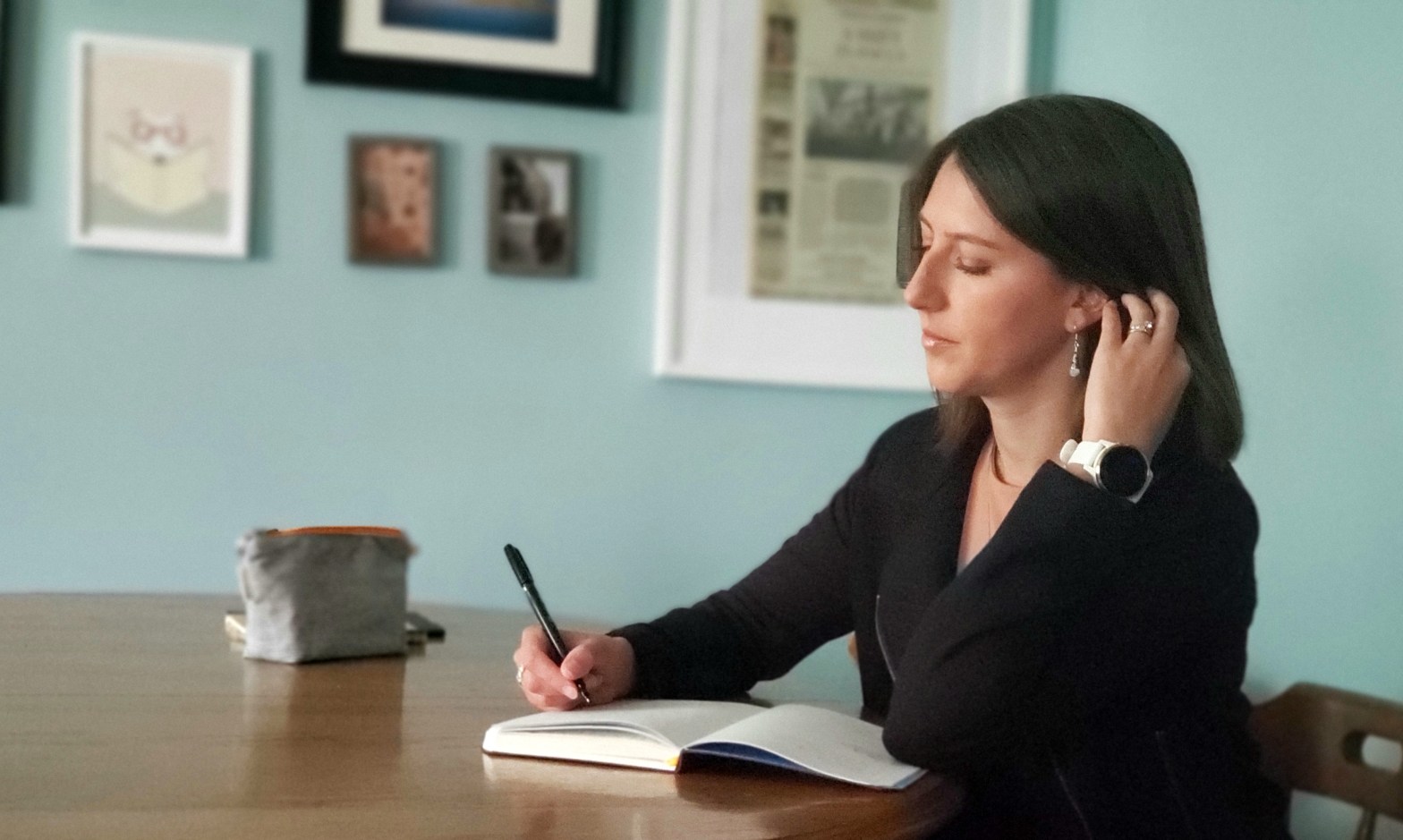
By Lauren Slagter
I wanted to share some of my favorite pieces I wrote in 2023. These eight vignettes touch on themes that continually came up in my writing this year and offer snapshots of what’s been going on in my world. I hope you find bits and pieces that you relate to or maybe a line that puts into words something you’ve been trying to articulate. And if not, that’s fine too 🙂
- I Made it Up
- You Can Try to Connect
- On Serving Tacos
- What We Owe Each Other
- Survival
- A 26.2-mile Path of Love
- On Being Together
- A Cento to Self
I Made it Up
I made it up – this community centered around writing, this space for strangers to come together to put words to their experiences and share little pieces of themselves with others.
Won’t you celebrate with me that we are here? That we all have something to give and we all have something to learn.
Won’t you celebrate with me what I have shaped into a kind of life?
I made up this life built on words. No one told me I couldn’t, or if they did, I didn’t listen. I just went on writing. Went on and married a writer, because who needs money and who needs stability when you could build a life out of words? Well, now I’ve got the money and stability – a reality that continues to surprise me – and still I crave the words.
I made it up, this life with my love and a mutt dog in this quirky old house built into a hill, surrounded by tall trees that make me feel at home.
Celebrate that I have found love in comfortable silences, in knowing looks shared across the table, in a well-timed hug in the dark corner of the kitchen.
Celebrate that I come from women who read me books and taught me the names of wildflowers that grow in the ditch in northern Michigan and showed me how to create family – an art of welcoming not exclusive to blood.
Celebrate that I am delighted at becoming an aunt and feel sure I do not want to be a mom. I made up this idea that I can contribute in ways other than having kids.
Won’t you celebrate with me that we made it this far? I made up a compass of love and acceptance to guide me. And somewhere in the fits and starts, the chaos and the detours, I scraped together a bit of wisdom. Somewhere along the way, I found a little more of myself and figured out how to be in this world. This world we made up, made ours.
Inspired by “Won’t You Celebrate With Me” by Lucille Clifton
You Can Try to Connect
You can’t have it all, but you can have a group of women gathered in an apartment living room, talking through their own personal brands of being overwhelmed. You can lean on each other and laugh as the cats who live there run through the room.
You can’t have it all but you can have a gathering of another group of friends – some you’ve gotten to know over the past year and some who are new to town. You can wonder what you all really have in common, but you can keep showing up wholeheartedly.
You can remember how in the midst of lockdown, isolation felt so hard and you would have given anything for simple human contact. It turns out community is hard too, in a different way, and maybe it always was or maybe you all have forgotten how to be together. But you are together now and you have to make it work.
You can’t have it all, but you can recognize when you need to step back and let someone else take the lead. You can know when your perspective is not the perspective that needs to take up the most space in the room. You can listen when someone explains that “you guys” is not gender inclusive, and you can stop yourself from replying that this phrase is baked into the marrow of your Midwest bones, so if you let your guard down it might escape from your lips from time to time.
You can try to be helpful.
You can’t have it all, but you can make small talk over lunch in the office common space. You can go to happy hour even though you’re not drinking. You can ask “what did you do this weekend?” and “what gives you hope?” and “can you say more about that?” and “what do you think we should do next?”
You can try to connect.
Inspired by “You Can’t Have It All” by Barbara Ras
On Serving Tacos
Bear with me, I want to tell you something about community.
Community tastes like homemade guacamole and sweet watermelon. It looks like refried beans spilled on the floor of the car en route to the group dinner. It sounds like the clink of silverware as we set out 40 place settings on folding tables in the church gym; napkins folded on the left side of the plate, stemmed water glasses placed on the right.
Community gathers with friends in the kitchen to pray before lining up to serve tacos. It says “How have you been?” and “Would you like mild or medium salsa?” and “What’s in the rhubarb surprise?” Community smiles, jokes, and offers thank yous as it fills its plate. It scoops up broken taco shells from the floor while its hands sweat inside crinkly plastic gloves.
Community is the warm gratitude filling my chest as I watch these two spheres of my life intersect over dinner. My friends showing up because I asked them to, because I told them about the important work this group does and wanted them to be part of it. And this group showing up to welcome and appreciate my friends.
Community moves to a meeting room after the meal. It feels like a dry erase marker gliding across a whiteboard, listing event goals and advocacy priorities. Can we work with food pantries to center people’s dignity in how food is distributed? How do we encourage more landlords to accept Section 8 vouchers? Why aren’t more people talking about Black maternal mortality?
Community means no individual has to face these issues alone.
Community is trying not to talk over each other as the energy builds in the room. It asks the quiet ones to speak up.
Community insists that we – a dozen people from different socioeconomic backgrounds, professional backgrounds, life stages, races, and genders – can get on the same page about the type of difference we want to make. Community sounds like a round of applause for ourselves when we finally reach consensus. And now the real work begins.
Inspired by “Coconut” by Paul Hostovsky
What We Owe Each Other
This is what they do: Stand at the median between four lanes of traffic, sit at a downtown intersection, pace the sidewalks. Holding signs, selling newspapers. Notice their skin worn by long days in the sun, long nights exposed to the elements.
Sometimes I awkwardly try to avoid eye contact. Sometimes I smile, and sometimes I hand over whatever few bills I have on hand. I’ve written with some of these folks I see on the downtown street corners. I’ve asked them what’s on their minds and what call to action they’d want to deliver to their city. They talk a lot about basic decency, small kindnesses, the difference a smile from a stranger makes. Notice that the subtext is how dehumanizing their time on the streets has been.
My Christian friends ask me how I think we should respond to people living on the streets. I guess because I spend my days copy editing poverty research reports and my free time volunteering with anti-poverty advocacy efforts, they think I might have an answer. But I’m not sure that I do. It feels like a big question – a question about what we owe each other, wrapped in religious ethics. And sometimes I hear in the question a hint of assumption that those of us who are middle class and more affluent inherently know best how to help those of us who are poor.
I find that people tend to ask the question in one of two ways. One is: Will my money harm them in some way? What if they spend it on vices? I say it’s up to you how you respond if you feel called to be generous. I politely suggest that how the person spends the money is actually none of their business. I gently nudge them to consider why they feel so sure that their judgment of how the money should be spent is better than someone else’s.
The other way people ask that question is: Is it enough to give a few dollars? Should I get them groceries or book them a hotel room for the night? WWJD, right? I say it’s up to you how you respond if you feel called to be generous. I tell them they’re not single-handedly responsible for moving people off the street, but if they want to do more than give a few dollars, there are lots of ways to get involved.
I don’t know if these are good answers. So over after-work drinks one day, I asked my co-worker – a religion and ethics professor – what he makes of all this. He said what the money means to the person giving it and to the person receiving it are two separate things. He said sometimes it’s good for me to give $20 to someone on the street, regardless of what it means to them or how they use it.
His words were still in my ears a few days later when I was at the grocery store and the man behind me in the checkout line asked if I could help him out because he was out of money. He had a gift card in his hand, and I asked how much he wanted on it. Twenty dollars, he said. So I paid for the gift card, because that’s what he said he needed and it was good for me to give it.
Inspired by “Touch the Earth (once again)” by Juan Felipe Herrera
Survival
A woman can’t survive by her own breath alone. She needs to put her bare feet in the soft dirt and let the cornstalks swallow her up as she runs between the rows.
She needs to wade into the water, to throw herself chest first into the waves and give herself over to the boundless blue. She needs to soak in this glimpse of eternity; the waves’ constant motion and unchanging tides.
A woman needs to linger in the woods, to listen to the whispered wisdom of the towering pines, to let the quiet fill her.
A woman needs to look down from the mountaintop, to know that she is small and vast and she can make her way around and over jagged obstacles and steep climbs.
A woman needs to lie back in the grass and look up at the sky, to merge with this endless expanse and know she’s enough to cover it all.
Inspired by “Fire” by Joy Harjo
A 26.2-mile Path of Love
The question: Is this the path of love? 4:30 a.m. alarm. Coffee in mug. Water bottle full. Toast with peanut butter, banana, and honey – the perfect race day breakfast. LFG!
Is this the path of love? Me and my brother’s wife shivering in the predawn dark in downtown Detroit on our way to the starting line. The man who works at the transit center telling us we can use the bathrooms inside, instead of waiting in the long line of runners vying for the porta-potties on the street.
Is it this? The first few steps in this journey of over 26 miles, the culmination of months of training. People lining the streets early on this October Sunday morning, shouting at strangers: “I’m proud of you” and “looking strong.”
Watching the sun rise over the Detroit skyline from the Ambassador Bridge as we cross the Detroit River to enter Canada. Waving to the Canadians gathered to cheer us on, and laughing with the border security guard who welcomes us back to the USA when we emerge from the underwater tunnel.
This is the long, sometimes grueling, sometimes empowering, sometimes heart-tugging path of love. One foot in front of the other, mile after mile. Checking our pace, popping energy gummies into our mouths every few miles, pumping our fists in time to the music playing along the course. Drawing momentum from the spectators and other runners to keep us moving forward.
Reminding each other of our whys. I am running this for her – using my experience with three previous marathons to guide her through her first, setting aside my obsession with performance metrics and my hyper-competitiveness with myself to focus on supporting her. That’s my path of love.
Latching on to a pace group in the final miles when the going gets really tough. “That was our 20-mile warm up,” I tell her. “The real race is these last 6.2 miles.”
Is this the path of love? I ask myself the question when she goes silent toward the end – no more energy for jokes or stories – and falls a stride or two behind. I turn to tell her she’s stronger than this marathon, that this is her postpartum victory lap, that we can do hard things. LFG!
Then this path of love takes us through a screaming crowd of spectators who insist we’re almost done. And there’s my parents and my husband cheering us on. I tell her she’s going to see her beautiful baby soon and this will be the last hard thing she has to do for the rest of her life. And then there’s my brother and the baby and the finish line.
And somehow we’ve got a final burst of energy to cross that finish line smiling and I wrap my arm around her at the end as my legs disintegrate into jello and I’m so glad the path of love has led me here.
Inspired by “The Question” by Rosemerry Wahtola Trommer
On Being Together
Everywhere we turn, there is an entrance. The joke he’s made a million times, but I still respond with at least a smile because he still makes the effort of trying to get me to laugh.
The way we finish each other’s sentences sometimes. Or a friend makes a comment and it reminds us both of the same thing at the same time and our eyes meet across the table, and that’s an entrance too.
There’s reaching across the bed to lay my hand on his chest in that moment in the middle of the night between rolling over and falling back asleep.
There’s the way he lays out half a dozen records on the carpeted floor of the upstairs home office and asks me to pick one to listen to. He describes them as scuzzy and fun, rhythmic and a little distorted and modern. There’s an entrance in the adjectives he plucks from the air. I pick an album for our “close listening session,” and he settles into the worn leather chair we snagged off the curb outside our neighbor’s house and wheeled home together, laughing. I lean back in the desk chair opposite him, look out the window and find another entrance in the tree branches dancing in the day’s fading light.
There’s the way he attaches stories to songs and the way I’ve started to do that too. So when I hear The Magnetic Fields’ “Luckiest Guy on the Lower East Side,” I’m caught up in the story of how we met at that small-town newspaper where I fell in love with him and the news and the reporters we worked with, all at the same time. In this story, I’m driving on a sunny afternoon, listening to that song on the first burned CD he made for me. That’s an entrance too.
There’s the way I want the butter kept on the counter and he wants it kept in the fridge. The entrances we both leave scribbled on scraps of paper all over the house: to-do lists, phone numbers, grocery lists, the lede of a story, a travel wishlist, what we’re grateful for, and what we need from each other. It’s all written down somewhere.
The way we start each morning sitting side-by-side in the breakfast nook, sipping coffee and petting the dog after he’s finished his kibble.
Everywhere we turn, there’s an entrance, a door we can walk through to be together.
Inspired by “An Entrance” by Malena Morling
A Cento to Self
You are not the broker of peace between people so hurt by each other they cannot even have a conversation. You are not responsible for his sobriety. You are not his stress relief or diffuser of his anger. You are not going to decide the fate of his relationship and what it might look like to start over.
You are not in control, so go ahead and surrender that illusion. Take some weight off your shoulders – weight that’s not helping anyone and no one asked you to carry in the first place.
You are the tall grass grazing sun-kissed skin as we follow a narrow trail across the field.
You are the string of lights softly glowing on the roofline of the back deck as the sun sets and the trees fade into the growing shadows.
You are a pendulum swinging, because there’s balance to be found in reaching for a wide range of experiences without getting too attached to any of it.
You are muddy running shoes and pink satin high heels with pink nail polish covering bruised runner’s toenails.
You are the woman at the punk rock show whose face breaks into a wide grin as soon as the drum beat starts, and you are the man on the bus singing to the driver.
You are learning again, as you’ve learned before, that your love cannot save anyone. But it’s worth it to go on loving them anyway.
You are the sweetness of a strawberry milkshake, because he’s trying to give himself a little present every day.
You are hot humid nights grasping for each other in search of connection and love and a moment of passion.
You are tender green shoots, nourished by the decay of what you let go of last season.
You are beads of sweat running down the spine and a rush of cool relief from wading into the waves.
You are a perfect summer drive back from the beach, the five of us filling the jeep with a little black-and-white dog stretched across our laps in the backseat.
You are selfish and generous, shy and forceful.
You are a mug of coffee gone cold and reheated and the hard green tomatoes forming on the vine.
You are dancing for hours that feel like minutes and watching dawn break from the night sky in time to the techno beat.
You are a swishy skirt against freshly shaven legs.
You are popcorn kernels stuck between the teeth and a sing-a-long to “Wagon Wheel” played on guitar and accordion in a cafe.
You could be content with what you are. You could stop striving. You could be at home here.
Inspired by “You Are Not” by Mona Arshi. A cento poem is a patchwork of lines from other poems; this is a patchwork of lines from other pieces I wrote this year.
Would you like to try this type of writing?
Check out Finding Your Voice Writing Group!
 Lauren Slagter